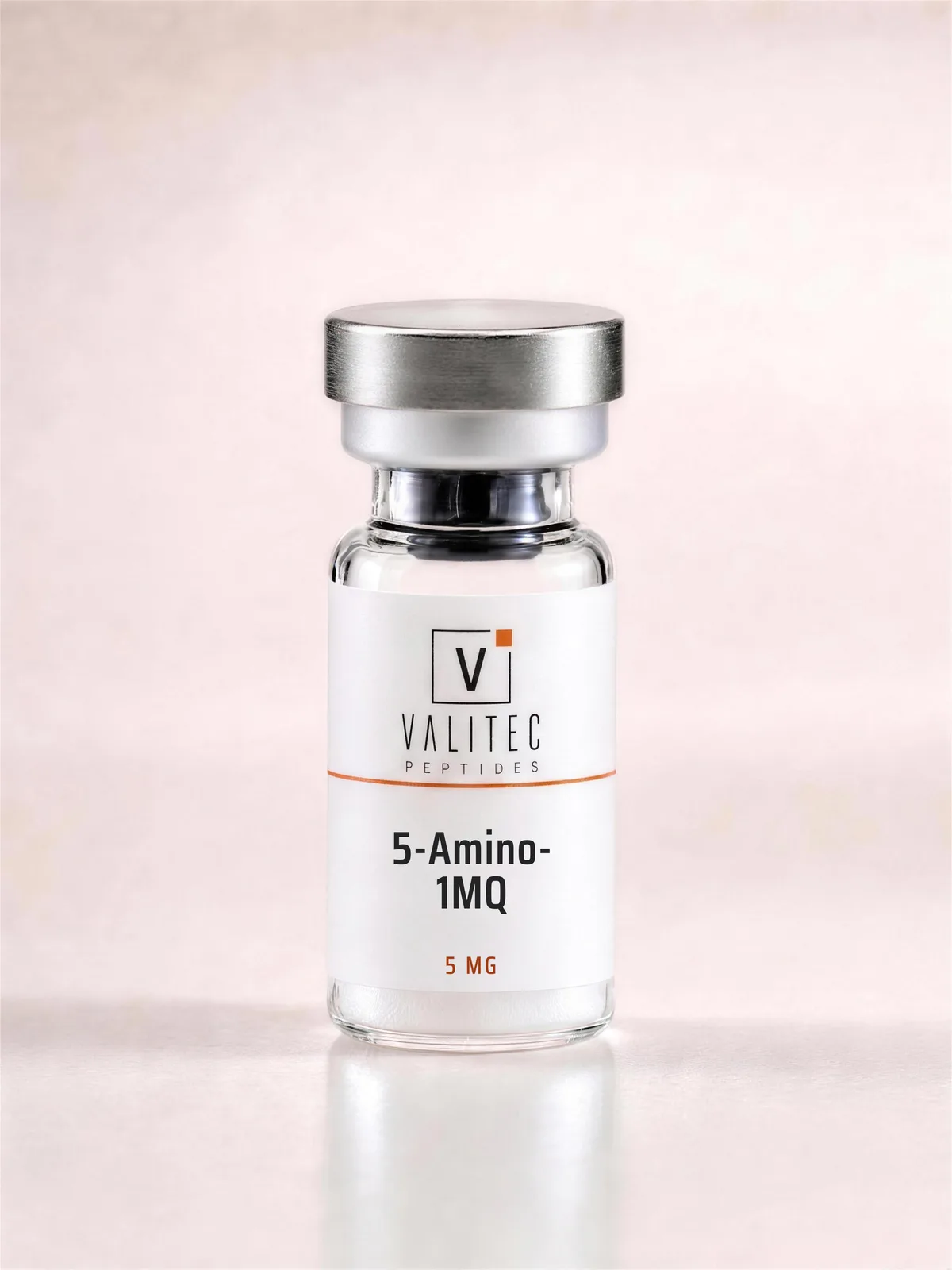
What does receptor binding research mean for 5-Amino-1MQ?
5-Amino-1MQ is a small-molecule research compound studied as an inhibitor of nicotinamide N-methyltransferase (NNMT). Strictly, NNMT is an enzyme and not a receptor, so binding studies with this compound are enzyme-ligand binding experiments. They use the same biophysical toolkit as receptor work, applied to a cytosolic methyltransferase.
This article describes how such studies are framed: the target, the assay formats, the controls and the documentation. It does not describe any use of the material in organisms. Everything here is for research purposes only.
What identity data does the catalog record?
The catalog records 5-Amino-1MQ under CAS number 42464-96-0, with a free-base molecular weight of 159.21 g/mol and a formula entry of C10H11N2. Purity is specified at 99%+, and the material is supplied lyophilized with storage at -20 °C. These values come from the brand's own product metadata.
The compound has no amino acid sequence. It is a compact heterocycle, so identity is established by mass spectrometry and chromatographic behavior against the expected weight. The brand's article on interpreting mass spec data explains how that comparison is made.
What is the binding target?
NNMT transfers a methyl group from S-adenosylmethionine to nicotinamide, producing 1-methylnicotinamide and S-adenosylhomocysteine. The enzyme therefore has two substrate-binding regions, one for the methyl donor and one for nicotinamide. Published structural analyses of NNMT inhibitors describe quinolinium-type scaffolds occupying the nicotinamide-binding region.
That structural picture is the reason a binding study is a natural companion to an activity assay. Activity data show that a signal changes, while binding data address whether the compound physically engages the protein. The brand's overview of 5-Amino-1MQ in in vitro models covers the cell-based side of the same question.
Which assay formats measure binding?
Several formats are used for small-molecule binding to a purified protein:
Surface plasmon resonance (SPR). The protein is immobilized on a sensor surface and ligand binding is read as a change in signal over time, giving association and dissociation behavior.
Isothermal titration calorimetry (ITC). Heat released or absorbed on binding is measured in solution, with no label on either partner.
Fluorescence polarization. A fluorescent probe that binds the target is displaced by a competing ligand, and the polarization change reports displacement.
Thermal shift assays. Ligand binding is inferred from a change in the temperature at which the protein unfolds.
SPR and ITC are direct formats. Fluorescence polarization and thermal shift infer binding from a secondary signal. Each has different requirements for protein quantity and ligand solubility, and a small molecule at 159.21 g/mol gives a modest signal in mass-sensitive formats such as SPR.
How are controls designed for binding studies?
A binding signal is only meaningful alongside controls that separate specific interaction from artifacts. Common controls include:
Reference surface or blank channel, to subtract bulk and non-specific signal.
Inactive or unrelated compound, to confirm the format does not respond to any small molecule.
Known competitor, to show the signal is lost when a ligand of the same site is present.
Solvent-matched buffer, because mismatched solvent produces a signal that resembles binding.
The last is a frequent source of error in label-free formats. Matching solvent between sample and running buffer is routine practice. Specific concentrations and run conditions belong in the investigating laboratory's protocol and primary literature, and are intentionally not given here.
How should binding data be interpreted?
A reported binding constant is a model-dependent number. It depends on the binding model fitted, on the quality of the protein preparation and on an accurate molar amount of ligand. That last point links back to identity: the molar amount is calculated from mass and molecular weight, so using a salt weight for a free-base entry shifts every derived value.
Binding affinity and enzyme inhibition are related but separate measurements. A compound can bind without inhibiting, and inhibition can arise from mechanisms other than direct binding to the active site. Reading both datasets together is more informative than either alone, and selectivity against related methyltransferases is worth examining before attributing an effect to NNMT alone.
How does ligand solubility affect binding experiments?
Label-free and fluorescence formats both require the ligand to remain in solution throughout a run. A small molecule that aggregates can produce signals that mimic binding, and aggregation-driven artifacts are a recognized problem in biophysical screening. Researchers usually check for them with detergent-sensitivity tests or by examining whether signal scales sensibly with the amount of ligand present.
Solvent choice interacts with this. Many small molecules are first dissolved in an organic co-solvent and then diluted into assay buffer, and the final co-solvent fraction has to match between sample and reference. How a particular laboratory prepares its solutions is a protocol matter and sits outside the scope of this article. The point here is that a binding constant is only as sound as the solution behavior behind it.
What orthogonal checks strengthen a binding conclusion?
One assay format rarely settles a binding question. Orthogonal checks, meaning independent methods that rely on different physical principles, reduce the chance that a single artifact drives the conclusion. A direct format such as ITC can be paired with an activity assay, and a thermal shift result can be paired with SPR kinetics.
Structural methods add another layer. Published crystallographic work on NNMT with bound inhibitors lets a researcher compare an inferred binding mode with an observed one, and mutating residues in the nicotinamide-binding region tests whether signal depends on them. Agreement across methods is stronger evidence than any one number, and disagreement is itself informative about assay limits.
What kinetic information can a binding study provide?
Equilibrium affinity is only one summary of an interaction. Time-resolved formats such as SPR also report how quickly a ligand associates with and dissociates from the target, and two compounds with similar affinity can differ widely in those rates. For an enzyme inhibitor, dissociation behavior bears on whether the interaction is better described as rapidly reversible or as long-lived on the timescale of the assay.
Small molecules near 159 g/mol often show fast exchange, which can place the signal close to the limit of detection in some instruments. Reporting the instrument, the fitting model and the quality of fit alongside any rate constant lets other laboratories judge the result. A kinetic claim without those details cannot be reproduced.
How does this compare with other catalog small molecules?
Binding framing differs by mechanism. AICAR, catalog formula C9H14N4O5 at 258.23 g/mol, is a nucleotide analog studied in connection with AMPK, so its binding questions center on a kinase regulatory site. SLU-PP-332, catalog formula C20H18F3N3O2 at 393.37 g/mol, is studied with the estrogen-related receptor family, which is a true nuclear receptor and suits receptor-style ligand binding.
Placing the three side by side is easier with a comparison view, and the brand's Amino Axiom compound compare FAQ walks through reading one.
What documentation should accompany the material?
Binding work is sensitive to impurities, since a minor component can itself bind the target or interfere with a signal. The analytical package should include an HPLC chromatogram showing purity, a mass-spectrometry result consistent with 159.21 g/mol for the free base, and a batch record tied to the lot received. The article on research compound sourcing documentation describes what to look for.
Specifications and available sizes are on the 5-Amino-1MQ product page. All material is supplied for laboratory research use only.
5-Amino-1MQ is a research chemical intended for laboratory and scientific research purposes only. It is not a drug, supplement, or food product, and is not intended to diagnose, treat, cure, or prevent any disease. Valitec Peptides does not supply products for human or animal use. Researchers are responsible for compliance with all applicable local, state, and federal regulations governing the purchase and use of research materials.
Reference
Common questions
In the literature 5-Amino-1MQ is studied as an inhibitor of the enzyme NNMT, not as a classical receptor ligand. Binding studies with it are therefore enzyme-ligand binding experiments. The same assay formats used for receptors apply, but the target is a methyltransferase. For research purposes only.
Common formats include surface plasmon resonance, isothermal titration calorimetry, fluorescence polarization and competitive displacement assays. The first two measure binding directly without a label on the compound. The others infer binding from a signal change. Each format has different material and purity requirements.
A binding constant depends on a correct molar amount of ligand, and molecular weight differs between a free base and a salt. The catalog lists 159.21 g/mol for the free base. Using the wrong form shifts every calculated molar value, so the form on the batch record should be matched.
Typical controls include a reference surface or empty-channel signal, a structurally unrelated compound, and a competitor known to occupy the same site. These separate specific binding from sticking to surfaces or assay components. Without them a measured signal cannot be attributed to the intended target.
A reported result should be tied to a lot number, an HPLC purity record and a mass-spectrometry result consistent with the expected molecular weight. Impurities can bind a target or interfere with a signal, so identity and purity data are part of the evidence for the measurement.