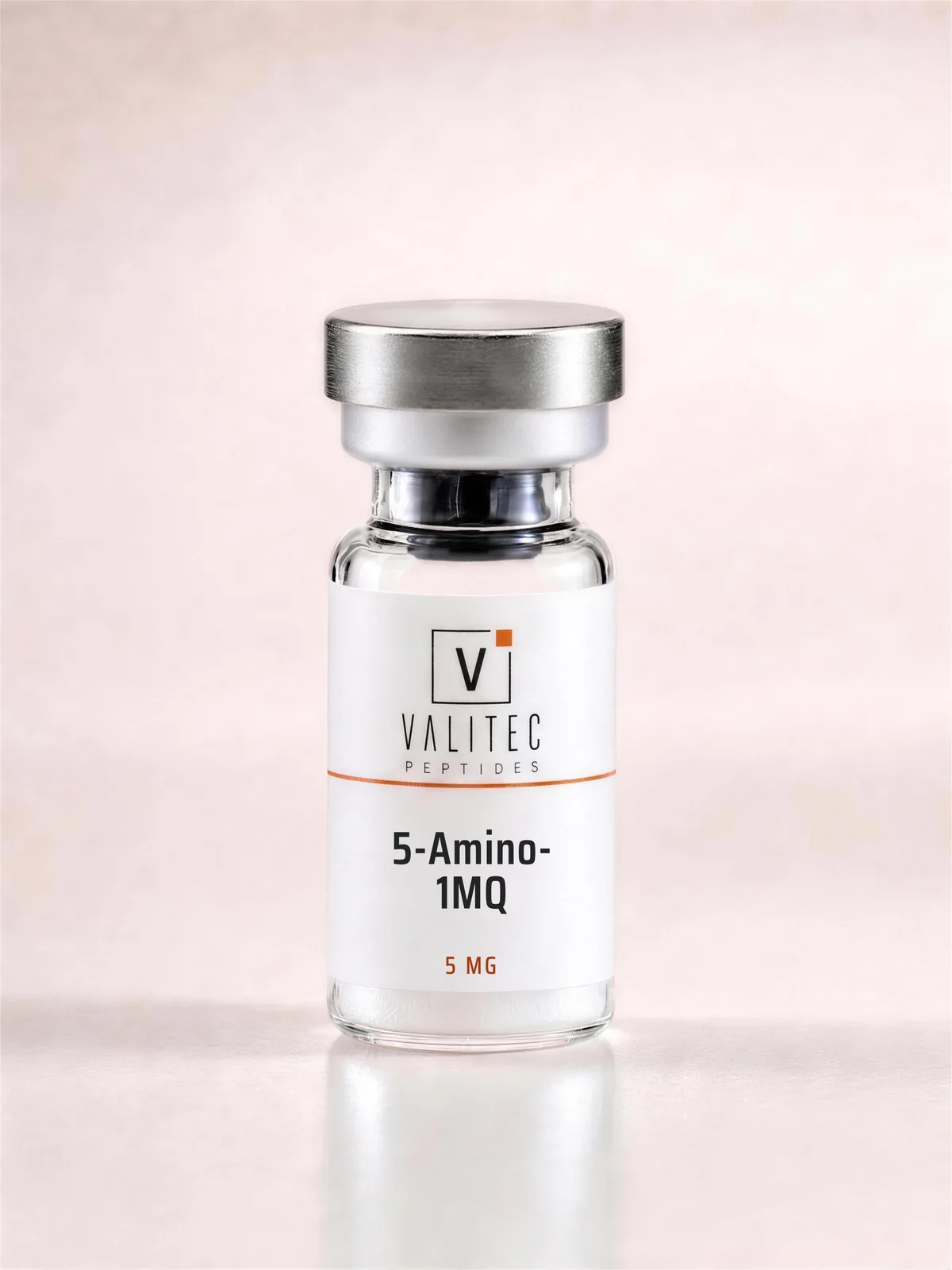
5-Amino-1MQ is a small-molecule research compound derived from a quinolinium scaffold, studied as an inhibitor of nicotinamide N-methyltransferase (NNMT). In this brand's catalog it is recorded under CAS number 42464-96-0, with a free-base molecular weight of 159.21 g/mol and a formula entry of C10H11N2. It is supplied as a lyophilized material for laboratory research only and is not for human or animal use.
Unlike the peptides that dominate most research catalogs, 5-Amino-1MQ is a compact heterocycle with no amino acid sequence. That changes how it is characterized: identity is established by mass spectrometry and chromatographic behavior against the expected molecular weight, not by sequence confirmation. It also changes how it behaves in cell culture, because a molecule of this size is generally able to enter cells without a dedicated carrier.
What is NNMT and why is it a research target?
NNMT is a cytosolic enzyme that transfers a methyl group from S-adenosylmethionine (SAM) to nicotinamide, producing 1-methylnicotinamide (1-MNA) and S-adenosylhomocysteine (SAH). The reaction sits at the junction of two metabolic systems. Nicotinamide is a precursor feeding the NAD+ salvage pathway, and SAM is the principal methyl donor for cellular methylation reactions. NNMT therefore draws on both pools at once.
Published work has examined NNMT expression across a range of cell and tissue models, and elevated expression has been reported in several of them. That observation is the reason NNMT inhibitors exist as research tools: if the enzyme influences nicotinamide and methyl-donor availability, a selective inhibitor lets researchers ask what changes in a cell model when the enzyme is blocked. The question is mechanistic, and 5-Amino-1MQ is one of the tools used to pose it. Valitec makes no outcome claims about these relationships.
How is 5-Amino-1MQ characterized structurally?
The catalog values are the starting point: C10H11N2 as a free-base entry and 159.21 g/mol. The scaffold is a methylated quinolinium ring bearing an amino substituent, and that ring system is what lets the molecule occupy the nicotinamide-binding region of the NNMT active site in published structural analyses of related inhibitors.
For analytical purposes, a compound at this molecular weight gives a clean, low-mass signal in electrospray mass spectrometry, and the expected ion can be calculated directly from the catalog value. Researchers should note that quinolinium compounds are charged species, which is why formula conventions differ between sources. Some list the cation, some list a salt, and some list a free-base description. Always match the form on the batch documentation to the form assumed in the experimental calculation. The brand's article on interpreting mass spec data covers how to read the spectra involved.
Why use in vitro models for NNMT inhibitor research?
In vitro systems give control that whole-organism work cannot. In a cell culture experiment the researcher sets the medium, the cell line, the time course and the readout, and can run a vehicle-only control in parallel. For a metabolic enzyme such as NNMT, that control is valuable because nicotinamide, SAM and downstream metabolites can all be measured directly in lysates or conditioned medium.
Several model types appear in the research literature on NNMT:
Adipocyte-lineage cell models, where NNMT expression has been characterized and where differentiation state can be tracked.
Cancer-derived cell lines, where NNMT expression levels vary and have been compared across lines.
Hepatocyte-derived models, where nicotinamide handling is a recurring subject of study.
Cell-free enzyme assays, which use purified recombinant NNMT to measure inhibition kinetics without cellular complexity.
Each answers a different question. Cell-free assays isolate the enzyme-inhibitor interaction. Cell-based assays add membrane permeability, intracellular metabolism and compensation by parallel pathways. A well-designed project often uses both, so that a result in cells can be traced back to a direct effect on the enzyme or to something further downstream.
What readouts are used in these models?
Because NNMT's reaction products are well defined, the readouts are fairly direct. Research groups have followed:
1-MNA levels, measured by LC-MS, as a direct product readout of NNMT activity.
Intracellular nicotinamide and NAD+ pools, to look at the salvage-pathway side of the axis.
SAM and SAH ratios, as a readout of methyl-donor status.
Cell viability and proliferation, run as a necessary control so that a metabolic change is not simply a reflection of cytotoxicity.
Expression of NNMT itself, by qPCR or immunoblot, to confirm the target is present in the chosen model.
The last two are easy to skip and costly to omit. A model that does not express NNMT cannot say anything about NNMT inhibition, and a signal that tracks cell death is not a metabolic finding.
How should experiments with 5-Amino-1MQ be controlled?
Good control design for a small-molecule inhibitor in vitro rests on a few habits. They apply to any enzyme inhibitor and are not specific to this compound.
Vehicle control. Every comparison needs a matched solvent-only condition run through the same procedure.
Target-presence check. Confirm NNMT expression in each cell line before interpreting any inhibitor result.
Orthogonal confirmation. Where possible, compare the inhibitor result against a genetic knockdown of NNMT. Agreement strengthens the inference that the effect runs through the enzyme.
Selectivity awareness. A small molecule can interact with related methyltransferases. Published selectivity work on NNMT inhibitors is worth reading before attributing an effect solely to NNMT.
Batch traceability. Record the lot number of the material used in every experiment, so that any later discrepancy can be traced.
Specific concentrations, exposure times and preparation methods belong in the protocol of the investigating laboratory and its primary literature. They are intentionally not given here.
How does 5-Amino-1MQ differ from other metabolic research tools?
It helps to place it among neighboring tools in the same catalog. AICAR is a nucleotide analog studied for activation of AMP-activated protein kinase, which is an energy-sensing kinase cascade. SLU-PP-332 is a synthetic small molecule studied in connection with the estrogen-related receptor family, which regulates transcription. 5-Amino-1MQ is different from both: it is studied as an inhibitor of a metabolic enzyme.
That difference matters for experimental design. A kinase activator, a nuclear receptor ligand and an enzyme inhibitor each need a different set of controls and a different readout panel. Grouping them under the label "metabolic research" is convenient for browsing a catalog and misleading for planning an experiment. The Amino Axiom compound library, covered in the brand's Amino Axiom compound library FAQ, is one way to compare these mechanism entries side by side.
What documentation should accompany the material?
For a compound at this molecular weight, the analytical package should include an HPLC chromatogram showing purity, a mass-spectrometry result consistent with the expected molecular weight, and a batch record tied to the lot received. Valitec supplies research-grade material held to a minimum 99%+ purity specification, with batch-specific documentation. For a full explanation of what to look for in those documents, see the article on research compound sourcing documentation.
Specifications, available sizes and ordering information are on the 5-Amino-1MQ product page. All material is supplied for laboratory research use only.
5-Amino-1MQ is a research chemical intended for laboratory and scientific research purposes only. It is not a drug, supplement, or food product, and is not intended to diagnose, treat, cure, or prevent any disease. Valitec Peptides does not supply products for human or animal use. Researchers are responsible for compliance with all applicable local, state, and federal regulations governing the purchase and use of research materials.