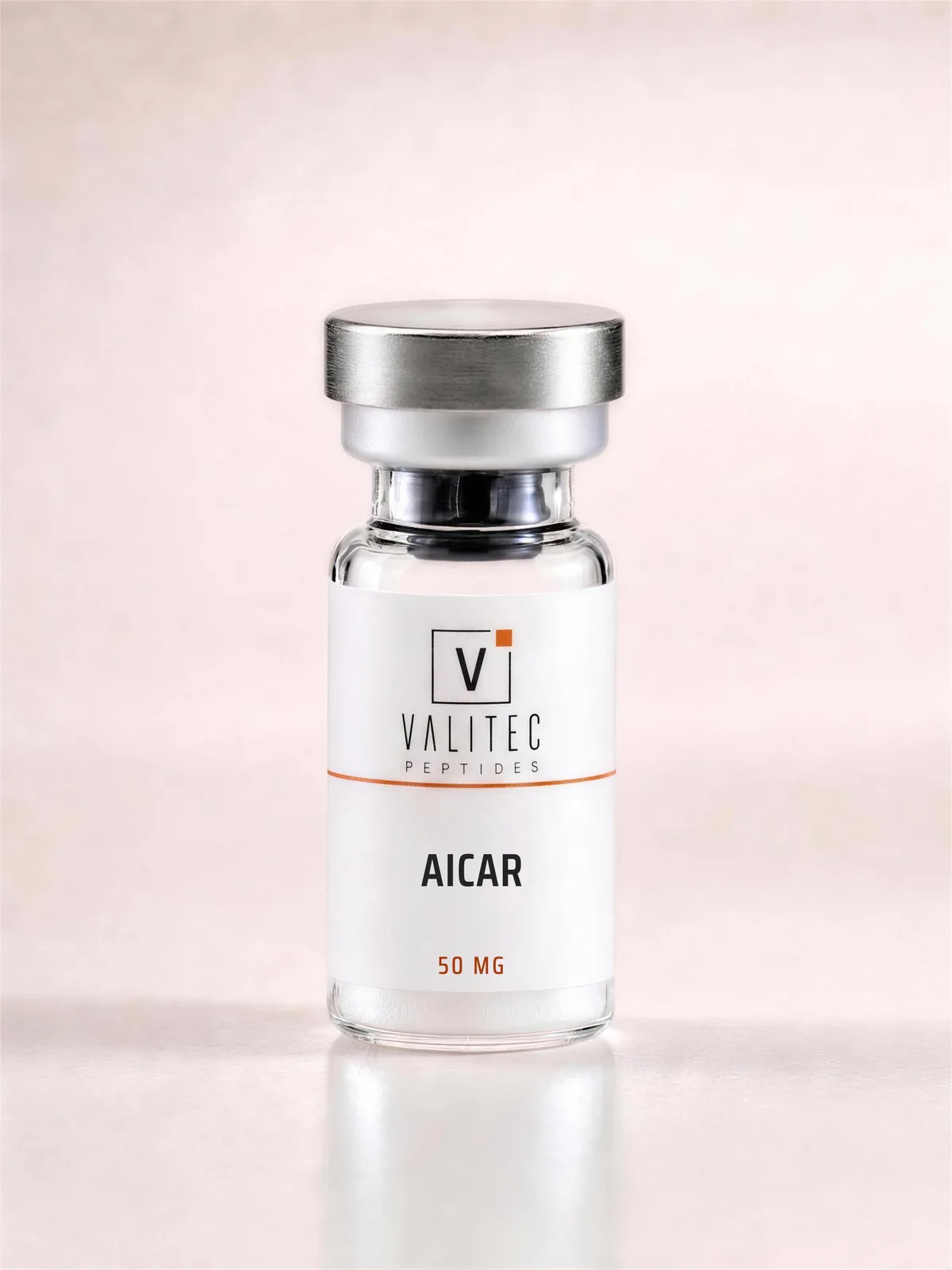
AICAR — 5-aminoimidazole-4-carboxamide-1-β-D-ribofuranoside, also catalogued as acadesine or AICA riboside — is a cell-permeable nucleotide analog studied in research for its activation of AMP-activated protein kinase (AMPK). It is catalogued under CAS number 2627-69-2 with a molecular formula of C₉H₁₄N₄O₅ and a molecular weight of 258.23 g/mol. Supplied as a lyophilized powder, it is intended strictly for laboratory research purposes and is not for human or animal use.
AICAR is categorized as a metabolic research compound rather than a peptide. Its structural basis is a modified nucleoside — specifically a ribose sugar conjugated to a 5-aminoimidazole-4-carboxamide (AICA) moiety. What distinguishes AICAR in metabolic pathway research is its role as a cell-permeable precursor to ZMP, an intracellular intermediate that activates AMPK without depleting the cellular ATP pool. The mechanism is discussed in detail below.
What is the molecular structure of AICAR?
AICAR has a molecular weight of 258.23 g/mol and the molecular formula C₉H₁₄N₄O₅. It is a nucleoside analog — structurally, a ribose sugar unit conjugated to a 5-aminoimidazole-4-carboxamide (AICA) heterocycle. This structure places AICAR in the class of purine synthesis intermediates: it is a naturally occurring compound in the de novo purine biosynthesis pathway, where it serves as a penultimate intermediate before the formation of inosine monophosphate (IMP).
As a synthetic research compound, AICAR is supplied in its non-phosphorylated ribonucleoside form. This is the cell-permeable form — small enough and appropriately lipophilic to cross plasma membranes by passive diffusion and nucleoside transport mechanisms in research cell models. Upon entering the intracellular environment, it is phosphorylated by adenosine kinase to yield ZMP (5-aminoimidazole-4-carboxamide ribonucleotide 5'-monophosphate), the AMP-mimicking metabolite responsible for AMPK activation.
The molecular weight of 258.23 g/mol reflects this relatively compact structure compared to peptide-based metabolic research compounds. Unlike lipidated peptides or multi-chain structures requiring specific cold-chain conditions primarily for oxidation resistance, AICAR's lyophilized form is stable at −20°C and is sensitive to moisture and light rather than temperature-driven oxidation of modified amino acid side chains.
How does AICAR activate AMPK?
AMPK — AMP-activated protein kinase — is a heterotrimeric serine/threonine kinase consisting of a catalytic α subunit and regulatory β and γ subunits. The γ subunit contains nucleotide-binding domains (CBS domains) that function as the sensor for intracellular adenylate energy charge. When the cellular AMP:ATP ratio rises — indicating energy depletion — AMP binds the γ subunit, producing three effects that collectively increase AMPK activity: allosteric activation of the α subunit kinase domain, protection of the activating phosphorylation at Thr172 on the α subunit from phosphatase-mediated dephosphorylation, and promotion of Thr172 phosphorylation by upstream kinases including LKB1 and CaMKKβ.
AICAR's intracellular metabolite, ZMP, structurally mimics AMP. ZMP binds the CBS domains of the AMPK γ subunit and produces allosteric activation of the kinase by the same mechanism as AMP — but without altering the actual AMP:ATP ratio in the cell. This makes AICAR a tool for studying AMPK-dependent signaling in isolation from the broader metabolic consequences of genuine ATP depletion.
In research models, this pharmacological selectivity is important. A compound that depletes ATP to activate AMPK would also trigger a range of secondary cellular responses unrelated to AMPK signaling itself. AICAR's mechanism allows researchers to study what AMPK activation does downstream — without the confounding effects of cellular energy crisis.
What downstream signaling pathways are studied in AICAR research models?
AMPK functions as a master regulator of cellular energy sensing. When activated — whether by genuine energy depletion or by ZMP derived from AICAR — it phosphorylates a broad set of downstream substrates involved in metabolic pathway regulation. Research using AICAR in cell and tissue models has focused on several downstream signaling axes.
Acetyl-CoA carboxylase (ACC) phosphorylation. ACC catalyzes the conversion of acetyl-CoA to malonyl-CoA, a committed step in fatty acid synthesis and a regulator of fatty acid oxidation through its inhibitory effect on carnitine palmitoyltransferase 1 (CPT1). AMPK phosphorylates and inactivates both ACC1 and ACC2 isoforms. In research cell models, AICAR-induced AMPK activation is frequently assayed by measuring pACC levels as a downstream readout of AMPK kinase activity.
PGC-1α transcriptional regulation. Peroxisome proliferator-activated receptor gamma coactivator 1-alpha (PGC-1α) is a transcriptional coactivator involved in the regulation of mitochondrial biogenesis and oxidative metabolism gene programs. AMPK directly phosphorylates PGC-1α at specific residues, and AICAR-mediated AMPK activation has been used in research models to investigate PGC-1α-dependent transcriptional responses. The cellular framing here is mechanistic: AMPK → PGC-1α phosphorylation → downstream gene regulation, studied in cell models. Valitec makes no outcome claims regarding these signaling relationships.
mTORC1 signaling. AMPK phosphorylates TSC2 (tuberous sclerosis complex 2) and Raptor, both of which act to inhibit mTORC1 activity. Because mTORC1 is a central regulator of protein synthesis and cell growth signaling, the AMPK–mTORC1 axis is studied in research models examining how cellular energy status cross-talks with growth factor signaling pathways. AICAR is used in this context as a tool to activate AMPK and observe downstream mTORC1 pathway responses.
GLUT4 trafficking in skeletal muscle cell models. AMPK activation has been studied in the context of glucose transporter 4 (GLUT4) translocation in skeletal muscle cell models. AICAR has been used as a research tool to investigate whether AMPK-dependent signaling influences GLUT4 membrane trafficking independently of insulin signaling, making it relevant to research examining insulin-independent glucose uptake mechanisms in cell culture.
These downstream applications are all framed within the context of receptor and enzyme signaling in research models. AICAR is a research tool for studying AMPK pathway biology — not a product intended to produce specific outcomes in biological systems outside controlled research settings.
How does AICAR compare to other AMPK-activating compounds in research?
Several distinct compound classes are used in research to activate AMPK. Understanding their mechanistic differences matters for research design, because each acts at a different point in the activation pathway.
Compound
Mechanism
Site of action
AICAR
ZMP-mediated allosteric activation via γ subunit AMP-binding domain
γ subunit CBS domain (AMP-mimetic)
Metformin
Complex I inhibition → elevated AMP:ATP ratio → AMPK activation
Mitochondrial electron transport chain (indirect)
A769662
Allosteric activation via β subunit carbohydrate-binding module
β subunit (distinct site from AMP/ZMP)
Compound 991
Dual α/β subunit binding, allosteric activation
α-β subunit interface
AICAR's mechanism — γ subunit activation without mitochondrial complex inhibition — means it activates AMPK through a different route than metformin or energy-depleting agents. In research contexts where distinguishing γ subunit-dependent from β subunit-dependent effects is experimentally relevant, the choice of activating compound is significant.
For comparison with ERR-pathway metabolic compounds that operate through a nuclear receptor mechanism rather than kinase activation, see SLU-PP-332.
What is known about AICAR's stability and handling in research settings?
AICAR is supplied as a lyophilized powder with a characterization specification of 99%+ purity by HPLC. Storage is at −20°C. As a nucleoside analog, AICAR is stable in its lyophilized form under appropriate conditions, but is sensitive to moisture exposure and should be protected from humidity. Repeated freeze-thaw cycles of reconstituted material can be a source of degradation in research settings, and researchers should determine appropriate handling protocols for their experimental system based on their laboratory's standard practices.
AICAR is water-soluble, which is relevant to research workflows involving cell culture. Its cell permeability has been established in numerous published model systems, where it crosses plasma membranes via nucleoside transporters and passive diffusion at concentrations used in typical research experiments.
As with all research compounds, handling and concentration-response parameters are determined by the individual researcher in accordance with their experimental design and applicable laboratory regulations. Valitec does not provide preparation or concentration guidance; researchers apply their own protocols.
How does Valitec source AICAR?
Valitec supplies AICAR as a research-grade compound held to a minimum purity specification of 99%+ by HPLC, with identity confirmed by mass spectrometry on a batch-specific basis. Each order is documented with a batch-specific Certificate of Analysis including the HPLC chromatogram and MS identity data. For analytical documentation standards in detail, see how to read research compound documentation.
Specifications, available sizes, and ordering information are at the AICAR product page. All material is supplied for laboratory research use only.
AICAR is a research chemical intended for laboratory and scientific research purposes only. It is not a drug, supplement, or food product, and is not intended to diagnose, treat, cure, or prevent any disease. Valitec Peptides does not supply products for human or animal use. Researchers are responsible for compliance with all applicable local, state, and federal regulations governing the purchase and use of research materials.